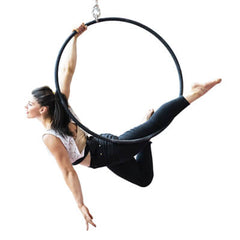
 Aerial Disciplines


 Handstand
 Balance
 Balls


 Clubs


 Juggling Rings
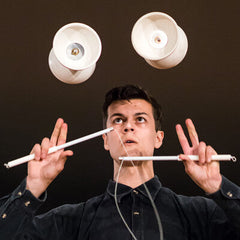 Diabolo
 Professional Silicone Clown Noses
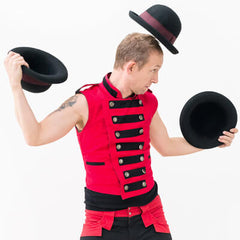 Manipulation Hats
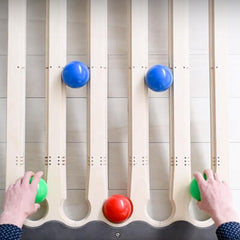 Juggle Board
 Soap Bubbles
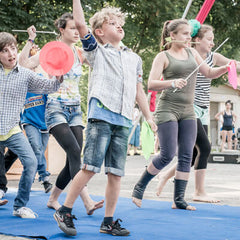 Circus Schools and Juggling courses
 Fire Props
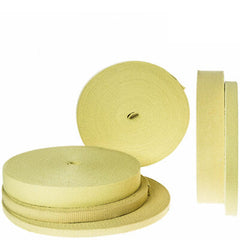 Kevlar® Wicks
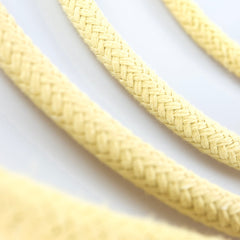 Kevlar® Ropes
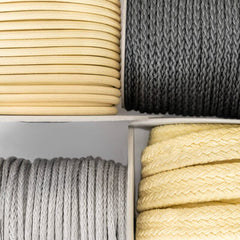 Special ropes in Technora and Kevlar®
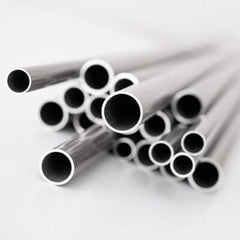 7075 - Tubing for fire prop manufacturers
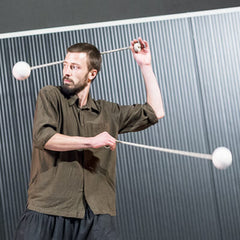 Contact Poi
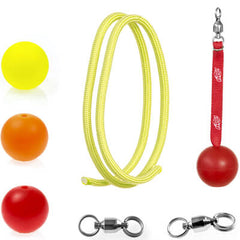 Poi and Flow Arts Components
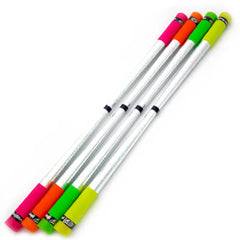 Devilstick
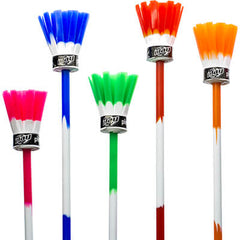 Flowerstick

How to choose CIRCUS DIVISION aerial hoops
Start with four questions
CIRCUS DIVISION makes one aerial hoop, designed and made in Italy. The tube is the same for someone who is still learning and for someone who already works on stage: what you choose is the diameter, the way the hoop is hung, and the pieces that join it to a structure a competent person has already checked. If you are still learning, use this page to order what your teacher told you.
- What outside diameter do you need, measured with the chair method?
- Will you hang it from one point, from two, or in a triangle?
- Are you fixing to a concrete slab, wrapping a beam, screwing into a wooden beam, or do you already have shackles?
- Do you want a ready kit, or the hoop plus tape and connectors on their own?
This page does not replace a course or a lesson with a teacher. Play sells aerial hoops to people who already train, and to beginners followed by a competent teacher. Always put a certified crash mat under the hoop. Do not train alone. Before you order an anchoring kit, have a professional confirm that the ceiling or beam can take a moving aerial load, not only the weight of a person standing still.
The right size
Play sells hoops by outside diameter, the measure taken on the outside of the tube. The space you sit in is the inside diameter, 5 cm smaller. Some other brands print the inside measure: if you compare that number with the Play catalogue, you are mixing two different measures, and the hoop that arrives is smaller than you expected. You notice when you sit and your knees have no room.
To find the size without guessing, sit on a chair with a straight back, measure from the seat to the top of the head, and add 10 cm. Those 10 cm leave room to sit without pushing against the tube, and a little air above the head. The number you get is the recommended outside diameter. If it falls between two sizes in the table, take the nearer one. Between two neighbouring sizes, for the first hoop the larger one is usually more comfortable to sit in: sitting well matters more than a centimetre less when you work at the top. When the gesture is more secure, you can move to a smaller size.
| Article | Outside diameter | Inside diameter | Weight |
|---|---|---|---|
| CDAHO85 | 85 cm | 80 cm | 4.75 kg |
| CDAHO90 | 90 cm | 85 cm | 4.95 kg |
| CDAHO95 | 95 cm | 90 cm | 5.20 kg |
| CDAHO100 | 100 cm | 95 cm | 5.45 kg |
| CDAHO105 | 105 cm | 100 cm | 5.80 kg |
| CDAHO110 | 110 cm | 105 cm | 6.15 kg |
There is a second way to measure, used when you already work foot holds on the top of the hoop. Standing, fold forward 90° at the hips, measure from the floor to the lower back and add 5 cm. The result can come out a little smaller, because it favours control at the top. If the two numbers do not match, for anyone still learning the chair method is better, unless your teacher says otherwise.
How to hang it
The hoop has three 10.5 mm holes drilled in the tube, with 55 or 60 cm between the two outer holes. The same hoop hangs in three ways: the movement changes, not the model. The piece that goes through the hole is a shackle: a small metal ring that closes and joins the hoop to the sling. A swivel is a joint, placed higher up, that lets the hoop turn without twisting the sling.
From a single point the hoop spins and swings in every direction, and it fits a smaller room. A swivel makes the rotation cleaner, because the sling does not twist. The CIRCUS DIVISION shackles are certified for a breaking load of 4000 kg (about 4000 daN): one shackle, on paper, would hold. Play still recommends using two, in the two closest holes on the tube, joined above on the same point. Two attachments on the hoop hold better than one, and that is why they are preferable when you can. Alternatively you can pass a polyester loop, without shackles. If you do not know where to start, start from here: it needs less space.
From a double point the hoop swings mainly forward and back, like a swing, and it is steadier when you stay in one position. The two straps stay parallel, each on its own attachment. It needs a little more height, and a structure that accepts two fixing points. You hang it with a pair of CIRCUS DIVISION shackles in the outer holes.
In a triangle you use two shackles as with the double, but the two straps rise and meet above, on a single point. The hoop spins as from a single point, and it does not rock like the swing. On top of that you have two straps to work on, the two legs of the triangle, for figures that use the slings. It needs a little more height than a single point, because the straps meet above the hoop.
In many studios the same hoop is hung in different ways according to the lesson. You can start from one point and later move to a double or a triangle, without changing the apparatus.
How this hoop is made
The tube is calibrated steel, 25 mm × 2.75 mm, black powder-coated against corrosion. Across the weld there is a double tube, a reinforcement at the point where the tube was closed. The hang points are holes in the tube, not welded tabs, so the profile stays smooth and there are no edges that catch skin or clothes.
- Maximum working load: 170 daN, about 170 kg. This is the load the hoop is intended to work with. Maximum breaking load: 1000 daN.
- Certification: European standard UNI EN 913:2019.
- Inspection by a competent person every 12 months, recorded on the hoop’s life sheet.
- Warranty: 3 years from the date of purchase. Designed and made in Italy.
The load that counts is that of the whole system, and the system is only as strong as the weakest piece: plate, anchors, beam, sling, shackle, hoop. Before you install, read the hoop technical specifications.
Shackles, sling and height
The CIRCUS DIVISION stainless-steel shackles are made for these holes. The pin has an O-ring, a small rubber ring that stops the pin unscrewing on its own, and the Allen key to close it is included. You can also hang the hoop directly from a polyester loop, with a girth hitch or a prusik, with or without a swivel. These are knots your teacher shows you: the first tightens the sling around the tube, the second locks when you load it and slides when you ease it.
To choose the length of the sling, measure the height of the anchor point from the floor. For home use Play recommends the hoop at about 120 cm from the ground: at that height you can sit and go head-down without hitting the floor. Lower, when you invert you touch the floor. Higher, in a domestic room, you risk the ceiling. The 75 cm double-sheath sling in the ready kits is sized for an anchor around 2.75–3 m.
Tape
Tape is a wrap you put around the tube. A powder-coated tube without tape slides more and can pinch the skin. When you are learning to sit and to climb, the friction of the cotton keeps hands and legs where you put them. Apply it from the bottom of the hoop, spiralling upward, on a clean dry tube, with no wrinkles. The stretch cotton tape measures 5 m × 50 mm, 95% cotton and 5% elastane: it follows the curve of the tube and does not leave sticky residue on the hands. The bare tube comes later, when the hands no longer slip: it is the same hoop, with or without tape.
Which kit for your ceiling
An aerial hoop hangs from a point a competent person has already checked. Stair treads, curtain poles, unverified trees and household furniture will not take a moving load. The kit you order depends on that structure.
| Your structure | What to order |
|---|---|
| You already have a verified hang point | The hoop only, or hoop + pair of shackles. |
| Ceiling around 2.75–3 m | Hoop + shackles + 75 cm double-sheath sling. |
| Concrete slab or wooden ceiling | Hoop + sling + ceiling plate and carabiner. The 12 cm plate accepts through-bolts or wood screws. |
| Exposed beam to wrap | Hoop + shackles + 75 cm sling + beam kit with 80 cm strap. |
| No suitable ceiling or beam | A freestanding aerial structure (TP420 / TP560 / TP700), on a suitable floor. |
If you need the plate detail, hole by hole, read the plate technical specifications.
Ready kit or single pieces
Every kit contains the same certified hoop, plus the pieces needed to hang it in that kind of room. The table above tells you which one to choose. Tape and bag are added separately.
- Hoop only.
- Hoop + pair of shackles.
- Hoop + shackles + 75 cm sling.
- Hoop + sling + plate and carabiner.
- Hoop + shackles + sling + beam kit.
- Tape. One 5 m roll covers a hoop. In a school, where the wrap wears, a second roll is useful.
- Padded bag. If the hoop has to travel, it protects the tube and the coating.
All hoops and kits are in the aerial hoop collection.
By situation
At home, after a real course
If your teacher has not asked for a specific hang, start from one point. Choose the kit according to the ceiling a professional has already approved. Keep the hoop around 120 cm from the floor and put tape on the curve, so hands and legs have grip from the first session.
School or gym
When the same hoop is shared among adults of different heights, 95 cm is often the middle size: it is a practical choice for a group, not the size that suits everyone. If you can, also keep a smaller diameter and a larger one, because sitting comfortably and working at the top do not ask for the same size. Have the hoop inspected every 12 months, and set it aside at the first sign of a crack, a bend that does not come back, or corrosion. A spare hoop means you do not cancel the lesson if one goes into inspection.
Spin, or work on the top
To spin more, or to work with the feet at the top, you may need a swivel, a little more height, or a triangle hang if you want the rotation of a single point and two straps to work on.
Before you put it in the cart
- A professional has approved the structure.
- The size comes from seat to head, plus 10 cm, and it is an outside diameter. Between two sizes, for the first hoop, take the larger one.
- You have decided how to hang it: one point, two parallel, or a triangle. If you are not sure, start from one point, with two shackles in the closest holes.
- You have CIRCUS DIVISION shackles, or they are already in the kit.
- The sling or plate matches the ceiling or the beam.
- Tape is in the order if you want grip from the first session.
- Under the hoop there will be a certified crash mat, and a competent person supervising.
Guide revision: 251004