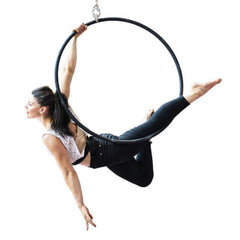
 Aerial Disciplines


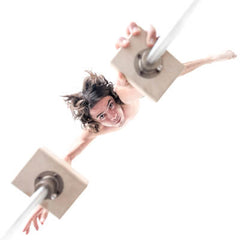 Handstand
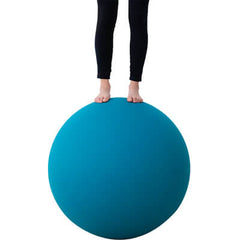 Balance
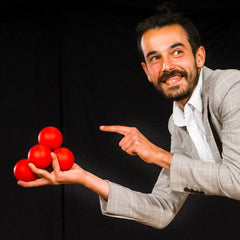 Balls
Balls


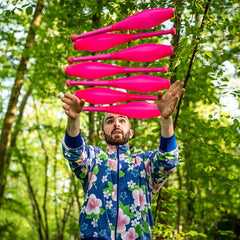 Clubs
Clubs


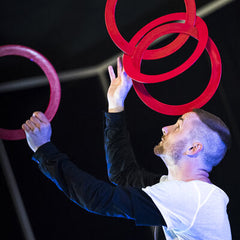 Juggling Rings
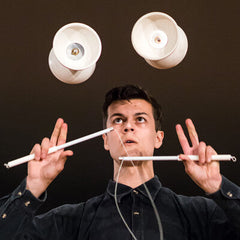 Diabolo
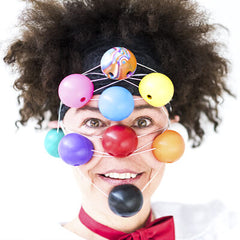 Professional Silicone Clown Noses
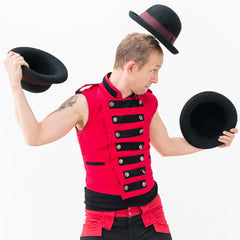 Manipulation Hats
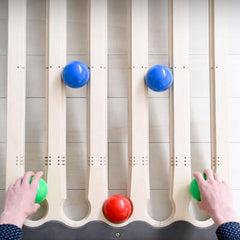 Juggle Board
 Soap Bubbles
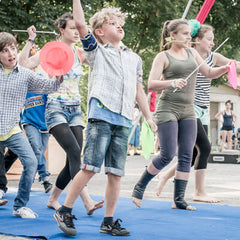 Circus Schools and Juggling courses
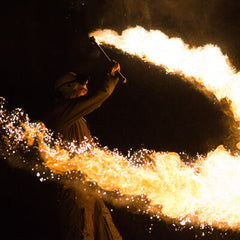 Fire Props
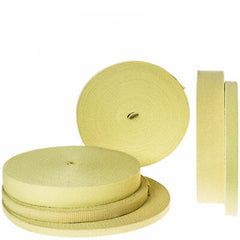 Kevlar® Wicks
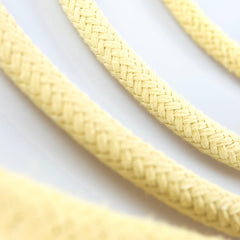 Kevlar® Ropes
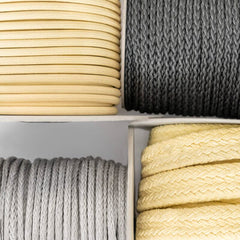 Special ropes in Technora and Kevlar®
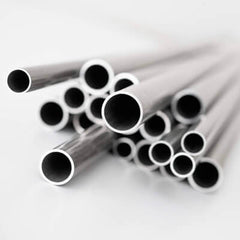 7075 - Tubing for fire prop manufacturers
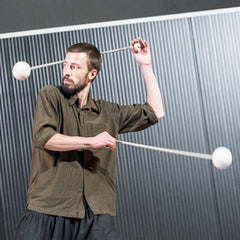 Contact Poi
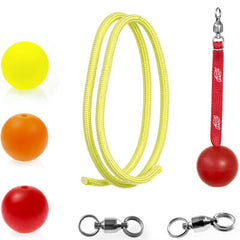 Poi and Flow Arts Components
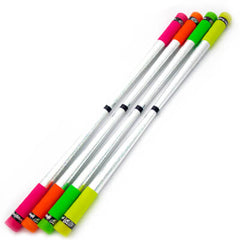 Devilstick
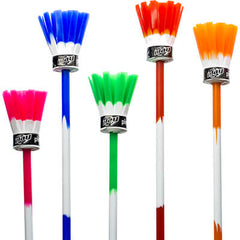 Flowerstick

How to choose contact poi
Start with four questions
Play builds, in Italy, the stage balls, and puts them at the service of contact poi: four diameters, two ropes, two knobs, thousands of combinations. There is no such thing as the perfect poi. There is the one you want to dance with — or, if that is the case, to throw.
Be careful with what you see in videos, and with advice from people who are already much further along than you. It is often useful, but sometimes, once someone feels “better”, they show off what they can do and recommend expert gear, forgetting what you actually need when you are taking your first steps. A video of someone doing five poi on 10 mm rope is a show by someone who already has a lot of practice, and it is not where you start. In the first months you need a rope that follows the hand, a ball you can drop without getting hurt, and an object with which to learn the basic movements. Be honest with yourself. Do not start with the most expensive prop just because the people you look up to use it. Better to go step by step: once you can move a pair calmly, there is always time to try a different rope or ball.
- Do you want to dance and have fun, or are you chasing throws and numbers?
- Are you learning, or do you already know what you want?
- Are you looking for a flexible 6 mm rope, or a compact 10 mm?
- Do you want a pair ready-made, or to build it yourself with the Generator?
If you are starting, choose a flexible 6 mm rope. Practice 70 or Standard 80 cover most people learning or teaching. A thicker, stiffer rope, in the first months, stays straight on its own. You are not yet learning to guide it with the hand: you are only following the shape it already has.
Two ropes
Both 48-spindle polyester, round, in many colours. They are not levels: they are two feels, two ways of moving. For a few years, around Bow Juggler and his five poi, many people have moved to 10 mm semi-rigid. Honour to anyone who plays five. The majority wants to dance: for them 6 mm remains the right choice, and it is not “for beginners” — it is the rope that follows the body.
| Rope | Feel | Why choose it |
|---|---|---|
| 6 mm | Flexible, thin, faster. The classic feel. | People starting, people dancing. Practice 70 and Standard 80. Also on PRO, 90 and Giga, if you want it. |
| 10 mm | Compact, semi-rigid. It holds its shape. Stable on throws. | Throws, manipulation, numbers. PRO, 90, Giga, Generator. It is not the starting point. |
The 6 mm is thin and flexible: in the hand you feel it, in the air it follows. It is faster, and that is why it forgives more while you learn isolations and rolls. The 10 mm is more compact, semi-rigid: it holds its shape on its own, and on throws it is more stable because it does not “flap”. If you do not throw, that stiffness is extra weight and extra resistance, not a help.
The models, ball by ball
Play poi start from the stage balls: weight, diameter, colour, touch. A larger ball, a little heavier, sits better in the hand and reads from further away; a smaller one is more agile, and easier to send flying if the gesture is still imprecise.
Practice 70 — 70 mm, 100 g, smooth 6 mm rope, ball swivel. No tails, no extras. Light, forgiving, Play parts. This is the poi with which to learn to move the arms and not to hurt yourself: if it arrives on you, 100 g barely registers. For first use, schools, anyone who wants to dance without worries.
Standard 80 — 80 mm, 150 g, 36 mm PX3 thermoplastic rubber knob, 6 mm rope. It is the first real contact poi: isolations, rolls, a little throw. The 150 g and the 80 mm give you surface and inertia to feel, without yet a throw counterweight. The knob is soft, exceptional grip: it is there to hold, not to throw five. Choose it if you already want a poi to hold in the hand.
PRO 80 — the same 80 mm ball, 39 mm PKS silicone knob. The silicone is a throw counterweight: serious grip, more weight in the hand. Stay on 6 mm if you still want to dance, or move to 10 if you already throw. Choose it if you throw, but 80 still works for you: it is not “the next step” for anyone still learning isolations.
90 mm — 165 or 180 g (Play is bringing the colours toward 165). More presence, more inertia: the ball stays in the air a little longer, and in the hand it reads better. Play aims it at anyone who already plays more poi. 6 or 10 rope, silicone knob. Choose it when the 80 flies away too fast, not in order to “level up”.
Giga 100 — 200 g. Maximum presence: stalls, rolls, slow manipulation. It is not a first poi. Choose it if you want mass, and you already know what to do with it: 200 g in the hand, for someone learning, is an object that tires before it teaches.
Two knobs
The knob is not an ornament: it is the weight you hold in the hand, and it decides whether the object invites you to dance or to throw.
The 36 mm PX3 rubber, on the Standard 80, is soft and it holds. It is for anyone who wants isolations and rolls: it fills the palm without becoming a counterweight. The 39 mm PKS silicone, on PRO, 90, Giga and Generator, is larger and heavier: throw grip. If you do not throw, it is extra weight in the hand, and it tires you sooner.
Length
On the contact line Play fixes ball and knob with nylon collars: you adjust the rope quickly, the look stays clean. On the Practice there is the swivel. If you specify nothing, Play cuts at 50 cm — by far the most common size, because it sits well on most bodies without already being “for numbers”.
Start from a length that reaches, arm outstretched, from palm to chest. Then shorten. Better a little long on day one than too short forever: a short rope does not lengthen, a long one you adjust. If you know the exact size, you can specify it in the Special requests field on the product page.
If it is not in the catalogue
Contact Poi Generator — price per single poi. Three balls (80 / 90 / 100 mm), two knobs, two ropes, eight colours plus glow. You can also put two different poi in the same pair, if your game is not symmetrical. If the catalogue does not have the combination you have in mind, you build it.
By situation
I have never held two poi
Start with a Practice 70 if you want lightness and forgive, or with a Standard 80 if you already want a real contact poi, with a knob to hold. In both cases: 6 mm rope. You do not need a “more pro” model to learn to move.
Dancing, isolations, rolls
Stay on 80 and on 6 mm: it is the size that follows the body. Standard if the rubber knob is enough; PRO if you already want silicone in the hand, knowing it is a little more weight. 10 mm does not help here: it holds its shape on its own, and you are still learning to lead it.
Throws and numbers
Here the rope changes, not only the ball. 10 mm rope, silicone knob: you need stability on the throw and grip. The 90 mm if you already play more poi; the Giga 100 if you want mass and you already know what to do with it.
Before you put it in the cart
- If you are starting or teaching: 6 mm rope, Practice 70 or Standard 80. 10 mm is for throwing, not for dancing.
- Rubber knob for holding and isolating. Silicone if you throw, because it is a counterweight.
- With no instructions, Play cuts at 50 cm: palm to chest, arm outstretched, then you shorten.
- If the combination is not in the catalogue: Generator.
Guide revision: 261005