 Aerial Disciplines


 Handstand
 Balance
 Balls
Balls


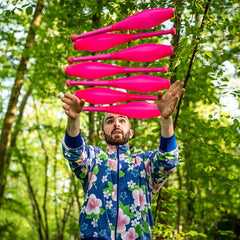 Clubs
Clubs


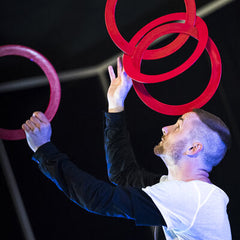 Juggling Rings
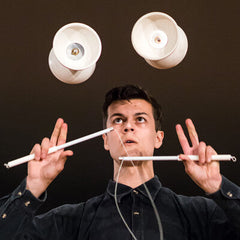 Diabolo
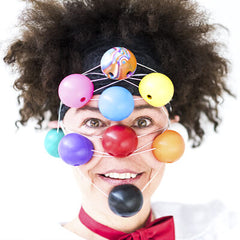 Professional Silicone Clown Noses
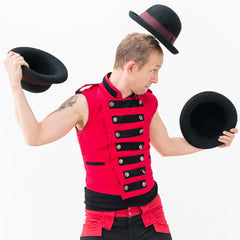 Manipulation Hats
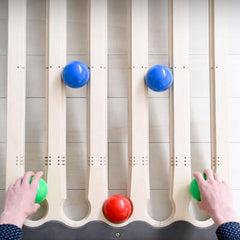 Juggle Board
 Soap Bubbles
 Circus Schools and Juggling courses
 Fire Props
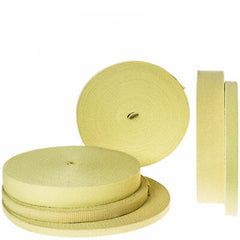 Kevlar® Wicks
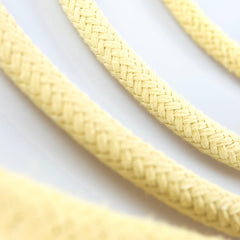 Kevlar® Ropes
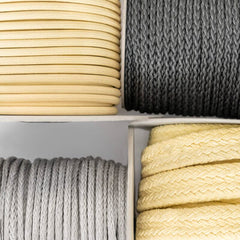 Special ropes in Technora and Kevlar®
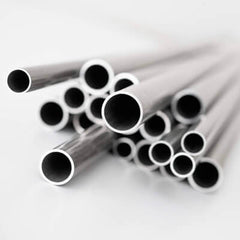 7075 - Tubing for fire prop manufacturers
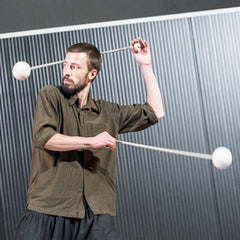 Contact Poi
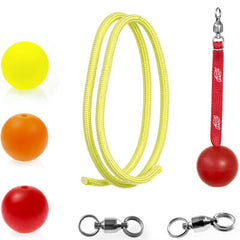 Poi and Flow Arts Components
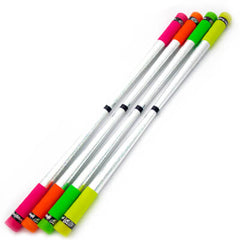 Devilstick
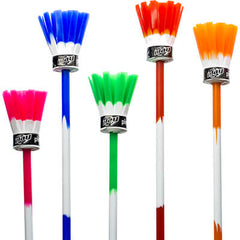 Flowerstick

How to choose juggling balls
Start with four questions
Play has made balls in Italy for more than thirty years, and more types than anyone else, because everyone throws a little differently. There is no such thing as the perfect ball: there is the one that sits well in your hands, with the way you are learning now.
Be careful with advice from friends who are further along than you. It is often useful, but sometimes, once someone feels “better”, they show off what they can do and recommend the ball they use today, forgetting what you actually need when you are taking your first steps. That ball, in the first month, is often not the one you need. Be honest with yourself. Do not start with the most expensive prop just because the people you look up to use it. Better to go step by step: once the basics of the throw are solid, there is always time to move to another ball. This page is here to make that difference clear.
- Are you learning to throw three balls, or do you already know the style you want?
- Are you working on three or four, or also on five and more?
- Air throws only, or also balances, body rolls, catches with the feet?
- Do you want a ball ready-made, or to build it yourself with the Generator?
If you are starting, take a BBX. When you are learning, the balls drop often, and that is normal. If they roll away, you spend more time looking for them than practising the throw. If two collide in the air and fly off, you lose the rhythm and have to start again. A BBX is soft: it stays where it falls, and if two balls touch they do not shoot away. This page is only about throws in the air. It is not about bounce balls, spinning, or contact, which is the work of the ball on the body.
Three families, three behaviours
Every Play ball has a phthalate-free PVC shell, made in Italy. What you feel in the hand is not “quality” in the abstract: it is how thick that shell is, and how full the inside is. That is where the behaviour comes from, and that is how you know which family you need.
A full, soft ball sits in the hand like a little bag: when two touch in the air they do not fly off, on the floor they do not roll, and if the throw is still uneven you have time to recover. This is where you start, and for many people it is also where you stay. In the catalogue they are BBX, MMX and TT1.
A soft Russian is only partly filled. The weight falls to one side, so on the floor it stops at once, and in the hand you can make it “die” (the dead drop) or hold it on a foot or on the head. That is a lovely game, but it already asks for a clean throw: if you are still chasing three, it makes life harder. In the catalogue SRX, TTS and SIL-X Light.
An elastic shell is about 4 mm: firmer, more precise, better suited to rolling on the head and body. It is not “the next level”: it is a different object, for anyone who mixes throws in the air with work on the body. SIL-X and HYBRID.
To get your bearings on thickness: the soft shells (MMX, TT1, TTS, SRX, SIL-X Light) sit around 2 mm. BBX is thinner still, 1 mm, which is why it feels like a cloth beanbag. 78 mm balls are glossy, with more stage grip; the smaller sizes are matte.
BBX: if you are starting, or teaching
For someone learning, the right ball is soft. Not because it is “for beginners” in a dismissive sense: because in the first months the throw is irregular, collisions happen, and you want a ball that stays put and forgives you, not one that runs away. The BBX is Play’s beanbag: a 1 mm soft PVC shell, full of millet, made in Italy. We recommend it to people starting out, to schools and courses that want to spend little and keep a ball that lasts, and also to professionals who use beanbags and want a ball that is docile, controllable, and a pleasure in the hand.
Before BBX, Play imported sewn beanbags — like almost every beanbag on the market — from Pakistan. Shipping and customs made the ratio of product value to import cost unsustainable. BBX let Play make that same feel in Italy, with a durability sewn fabric does not have: asphalt and concrete wear a cloth beanbag out fast; the BBX shell holds. The fill goes in through a 5 mm slit with an inner collar, no traditional plug: the millet stays in, air moves in and out, and the ball stays as soft as a classic beanbag.

The size almost everyone starts from is 68 mm and 130 g. It is not only “for three”: it is an all-round size. With a 68 you can learn, you can keep three and four in the air, and you can go on to five, six, seven if your hands allow it. If you are tall or have large hands, the 73 mm, 155 g fills the palm better and reads from further away. The 63 mm, 100 g makes sense if you have small hands, or if you already do high numbers and need more room in one hand for the start: it is not a step you have to take merely because you have begun five.
MMX: the firm millet feel
The MMX were Play’s best-selling balls before the BBX, and they remain a beautiful choice if the beanbag feels too “cloth-like” and you want something more solid and concrete. The shell is soft, about 2 mm, full of millet, and it holds a round shape. The throw is the same gesture as the BBX: what changes is what you feel in the catch. It does not bounce, and it does not roll like a stage ball.

Play still calls 67 mm, 135 g the “queen size”: like the BBX 68, it is a size that covers almost every toss style, not only the first three. The 70 mm, 150 g has more presence in the hand and on stage, if you have large hands or want the ball to read more. The 62 mm, 110 g is for small hands or for numbers, not the first ball for an adult of average height.
The other models, and why you would choose them
TT1 — the same idea as the MMX, but filled with plastic microspheres instead of millet. At 67 mm it weighs 130 g, a little less. The spheres do not crumble from impacts and they do not suffer from humidity: in a damp room millet seeds can swell and change the feel; microspheres stay the same. Choose it if you like a full soft ball, you want a fill that does not age, and you do not miss the crunch of millet. Sizes: 62 mm / 100 g, 67 / 130, 70 / 140.

TTS — a soft shell, but only partly filled with microspheres. On the floor it stops like a Russian; in the hand it stays soft. The spheres take up more volume for the same weight and slide against each other, which is why Play points it toward rolls, stops and balances without moving to a 4 mm shell. It is not the ball you learn three with: it comes later, when the throw is already clean. 67 and 70 mm at 100 g, 75 mm at 120 g.

SRX — Soft Russian, in the catalogue since 2005. The same soft shell, partial fill: quartz sand if you want the weight to fall sharply (a drier stop), millet if you prefer something gentler on rolls. It is for dead drop, foot and body catches, lightness. 67 mm / 100 g, 75 / 110, 78 / 120. The 67 and 75 are matte, also for multiplex; the 78 is glossy, more for the stage.

SIL-X — a Play invention: 4 mm elastic shell, one third of the volume in silicone oil (non-toxic, food-grade). The centre of gravity stays low, so it is stable on high throws and suited to foot catches and head rolls. The oil flows: unlike sand or pellet, the ball does not “flutter” if it leaves spinning. 67 mm / 110 g, 75 / 130, 78 / 150, 100 / 300. The 100 mm is for the stage and slow work, not for a cascade. The plugs come out so you can adjust the weight and reinflate after a flight in the hold. Choose it if you mix toss and body work, and you want a precise ball, not a beanbag.

SIL-X Light — the same oil, on a soft 2 mm shell. That softness makes them easier to catch: they squeeze against each other, so you can hold more balls in one hand. In the catalogue at 70 and 75 mm, around 90–100 g. You choose it for the lightness, and therefore to go up in numbers.

HYBRID — 4 mm elastic shell, partial millet fill. It rolls straight, stalls still, and holds a gentle russian on long rolls. Play aims it at anyone who, on the same ball, mixes throws in the air, a little contact and footwork. 75 mm / 150 g, 78 / 180. Choose it if a beanbag feels too small and an oil SIL-X already feels too “technical”.
PLUG&PLAY — semi-rigid shell, soft touch, 8 mm hole. Adjustable Russian: millet as standard (cleaner flight), sand or microspheres on request. 65 mm / 75 g, 75 mm / 100 g. Choose it if you already know what you want from the weight, and you want to be able to change it without changing the ball.


Ball Generator — soft or elastic shell, five diameters, fill of your choice, adjustable weight. If the catalogue does not have the combination you have in mind, you build it. That is Play’s job: not to sell you “the” ball, but to let you explore yours.
How a Russian ball works
A Russian is a specialised toss prop. Technical and sports jugglers favour it, especially for numbers (five objects and more). It is not a solid beanbag, and it is not a bouncy rubber stage ball: it is a hollow shell — firm or soft depending on the model — only partly filled with a loose, shifting material.
In general a ball is properly a Russian when the fill weighs more than the shell. The fill’s inertia wins: it commands the behaviour, and on the way down the path stays more vertical. Originally: fine quartz sand, salt or plastic pellets. In the Play catalogue, on that principle: quartz sand, millet, microspheres.
How the physics work
The defining trait is a low, shifting centre of mass. The ball is usually only about 25–35% full. How it behaves depends on whether it is in the air or in the catch.
In the air. When thrown, the sand (or other fill) settles at the bottom of the shell. Weight concentrates at the lowest point and acts like a pendulum. That very low centre of gravity makes the flight path more stable, resistant to mid-air collisions, and more vertical on the way down.
The dead drop (the catch). When the ball lands in the hand — or on the floor — the loose fill slams down against the bottom of the shell. Kinetic energy dumps there, and bounce dies. Completely: the ball does not rebound.
Why people use them
- Stability. The low centre of mass forgives a slightly inaccurate throw: they tend to self-correct in the air and resist wobbling.
- No rolling or bouncing. If you drop one, it stops exactly where it hits the ground. On seven or nine, you do not chase them across the room.
- Foot catches and stalls. Because they deaden on impact, they suit catching on the foot, stalling on the head, or neck rolls.
- Lightweight. They are often lighter than a full stage ball of the same size, which cuts arm fatigue on long numbers sessions.
The limits
- The wobble. Too much spin on release, and centrifugal force coats the inside of the shell with sand or pellets: the ball wobbles hard in the air. They want a clean, spin-free release. SIL-X oil flows: it does not behave that way.
- Rigid shells. Traditional Russians are hard — often play-pit balls, drilled and sealed. You cannot squeeze several into one hand for the start of a cascade. Play’s soft shells (SRX, TTS, SIL-X Light) compress; the 4 mm elastic ones (SIL-X, HYBRID) are firmer; PLUG&PLAY is semi-rigid.
- Hard-plastic durability. On traditional Russians, depending on the plastic, the shell can crack in the cold or if stepped on. That is not the story of Play’s phthalate-free PVC shells, made in Italy.
- Noise. Sand makes a “swish” in the air and a dull “thud” in the catch. Some jugglers find it rhythmic; others find it annoying.
It is not the ball you learn three with: it comes when the throw is already clean. We said that above, and it still holds.
From homemade Russians to Play
Early Russians were often DIY: a hole in a hollow sphere, sand inside, sealed with a glue gun. Play put the idea in the catalogue with PVC shells and more than one fill. The models that stay in this family are the ones whose fill weighs more than the shell.
- SRX — Soft Russian since 2005: soft shell, quartz sand (a drier stop) or millet (gentler on rolls).
- TTS — the same soft family, microspheres: dead drop, rolls and stalls without moving to 4 mm.
- PLUG&PLAY — semi-rigid, adjustable fill (millet as standard; sand or microspheres on request).
- SIL-X Light — a borderline Russian: fill and shell weigh about the same. They squeeze in the hand, light enough for numbers.
If the catalogue does not have the combination you have in mind, the Ball Generator lets you pick shell, diameter, fill and weight.
How big, how heavy
Play is a fan of the largest ball possible, as long as it still sits in your hand. You see it better, and so does anyone watching you. It fills the palm and so it asks you to keep an open, correct hand posture, while a very small ball invites you to squeeze and work close to the body. That is not a cosmetic preference: it changes the way you throw.
For the first three, many schools sit around 67–70 mm and 110–135 g. This is not a Play homologated size: it is what you see in the gym, and it lines up fairly well with what we recommend. For people starting we point to the BBX at 68 mm and 130 g. If you are tall or have large hands, the 73 sits better in the palm and reads from further away on stage.
67/68 mm is genuinely an all-round size. It is right for learning three, and it remains a perfectly reasonable size when you move to five, six or seven: plenty of people juggle seven 68 mm balls without feeling them “too big”. You do not need to drop diameter just because you have added two objects. You go down — toward 62 or 63 mm — if you have small hands, or if you already do high numbers and need more room in one hand for the start.
The opposite is just as true, especially on stage. A two-metre juggler with a 62 mm looks as if they are throwing marbles: the ball is there, but from a distance it disappears. Better a size that fills the figure than one that shrinks it.
By situation
I have never kept three balls in the air
Start with a BBX 68 mm. It is soft, it does not roll, and it forgives collisions while you learn the gesture. If you are tall or have large hands, take the 73 mm: it fills the palm better and does not invite you to squeeze.
I teach or buy for a class
The BBX costs little, lasts, and does not end up under the desks. For adults the 68 is the everyday size; keep a few 63 for small hands and a few 73 for anyone tall. You do not need a “more pro” model to teach three.
I want the millet feel, firmer
Then it is not a beanbag you are looking for, it is an MMX at 67 or 70 mm: the same full, soft family, 2 mm shell, full of millet. If you would rather avoid seeds — humidity, or a little less weight — the TT1 is the same throw with microspheres.
I already do five or more
You can stay on 67/68: it is all-round, and plenty of people do seven on it. Move to a BBX 63 or an MMX 62 only if in the start you feel the balls take up too much of the hand, or if you have small hands. A light soft Russian makes sense if the throw is already precise and you want the dead drop, not in order to “level up”.
Balances, rolls, feet
Here the family changes, not only the size. Stay soft in the hand with a TTS; take an SRX if you want the sand dead drop; a SIL-X if you work on head and body with a 4 mm shell and oil; a HYBRID if on the same ball you mix toss, a little contact and footwork.
Before you put it in the cart
- You are buying toss balls, not bounce, spinning or contact.
- If you are starting: a BBX, usually 68 mm and 130 g. It is an all-round size, not only “for three”.
- If you want the firm millet feel: MMX. If you want the same throw without seeds: TT1.
- Russians come later, when the throw is already clean: they serve a different game, not faster learning.
- Take the largest that still sits well in your hand. You drop diameter only if you lack room in the start, or if you have small hands.
Guide revision: 251005