 Aerial Disciplines


 Handstand
 Balance
 Balls


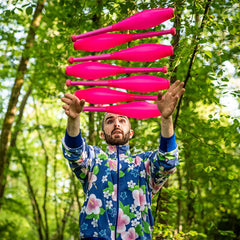 Clubs


 Juggling Rings
 Diabolo
 Professional Silicone Clown Noses
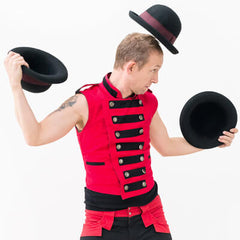 Manipulation Hats
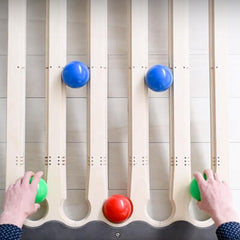 Juggle Board
 Soap Bubbles
 Circus Schools and Juggling courses
 Fire Props
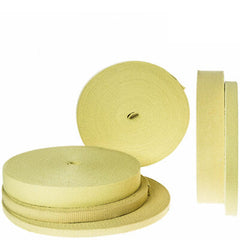 Kevlar® Wicks
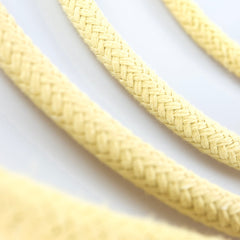 Kevlar® Ropes
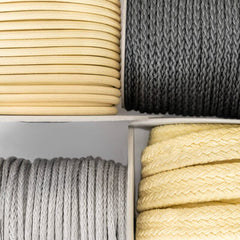 Special ropes in Technora and Kevlar®
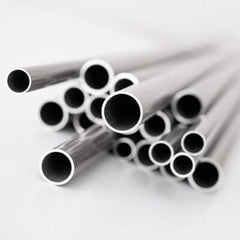 7075 - Tubing for fire prop manufacturers
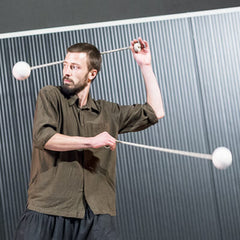 Contact Poi
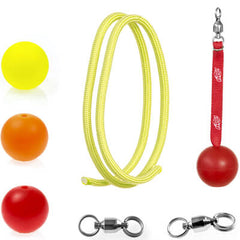 Poi and Flow Arts Components
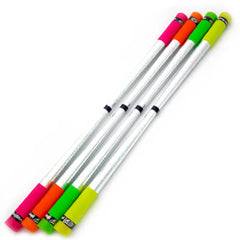 Devilstick
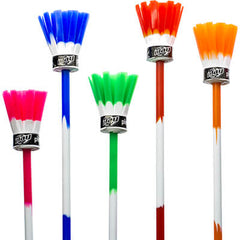 Flowerstick

How to choose juggling clubs
Start with four questions
Play has built clubs in Italy for more than thirty years. Two bodies, four cores, handles, colours: millions of combinations. There is no such thing as the perfect club. There is the one that flies the way you want.
Be careful with advice from friends who are further along than you. It is often useful, but sometimes, once someone feels “better”, they show off what they can do and recommend what they use today — usually a Pirouette, or a Sirius that looks like one — forgetting what you actually need when you are taking your first steps. In the first months you need something else: a handle thick enough not to hurt when the catch is not precise yet, a flight that stays manageable even if the throw is not clean, and a club that stands up to drops. Be honest with yourself. Do not start with the most expensive prop just because the people you look up to use it. Better to go step by step: once you can catch three clubs regularly, there is always time to try another combination.
And one thing holds for all Play clubs: they are made not to break. They land spinning thousands of times a day. Wood has a unique feel, but Play left it: we wanted durability, and the same weight to the gram from one club to the next.
- Are you learning to throw three clubs, or do you already know the style you want?
- Are you working on three or four, or also on five and more?
- Are you looking for the circus spin, or an object for manipulation, body, rolls?
- Do you want a club ready-made, or to build it yourself with the Generator?
If you are starting, begin with the Prima: the handle is thick and does not hurt while you learn to catch. When you are learning, clubs drop and they arrive on the palm in an irregular way. A thin “pro” handle, in those months, hurts and makes you squeeze. The Prima forgives the gesture, and it lasts.
Prima: for people learning, and for people teaching
Prima — one-piece, 52 cm, 200 g. One of the products we are proudest of. Never mind the “cheap” look: it is a fantastically balanced club, and it has nothing to envy in a pro club. Literally indestructible. The handle is thick, and it does not hurt when you start: that matters a lot. It is far better than many cheap import clubs that “look” more professional because they copy the look of expensive clubs, but are not worked out in centre of gravity or flight, and above all do not last. We recommend it to people starting and to people teaching; professionals still keep one in the bag.
Be careful with friends’ advice
Everyone is different and plays their own way. The advice of a juggler better than you is not always the right advice. With clubs this matters even more, because for thirty years one shape has filled almost the whole field of view.
When Play started making clubs, in 1996, it started from something very close to today’s Quantum. It quickly saw that Henrys already ruled the market with the Pirouette, by far the most popular club in the world.
Before the Pirouette, traditional circus used — and still uses — much shorter clubs: 45, 47, 49 cm. Super-fast, dynamic play, classic circus technique. Anthony Gatto used 49 cm (19 inch) clubs from our friends at Renegade Juggling for his whole career. Faster spin and weight make the club stable, perfect for that traditional technique.
The Pirouette, with a short body and a long handle, introduced something completely new: an object better suited to manipulation, which met the young modern juggler. Body movement, rolls, a wildly varied universe of use. From then on, 95% of the clubs used by modern jugglers have been Pirouettes. Play had no choice: it introduced the Sirius, dimensionally identical to the Pirouette, though mechanically different from day one. The wooden core was dropped for synthetics: weight consistency, infinitely greater strength.
The Pirouette has shaped the choice of so many people for thirty years. Everyone recommends it. If you want to play with the same clubs as your friends, 99 times out of 100 you need a Pirouette or a Sirius. Credit where it is due: good marketing. But there is something important.
Super modern jugglers such as Wes Peden, Spencer Androli and Moritz Rosner all use our Quantum EX1. These are the highest technical levels, the ones everyone watches. So is the Pirouette really the “best” club, or is its popularity mainly the result of years of spread and word of mouth? It is worth not assuming there are no alternatives just as valid — or even better — for your style and your level.
Two bodies: Sirius and Quantum
Both 52 cm. They are not levels, and it is not that “first you take Sirius and then you move to Quantum”. They are two geometries, two centres of gravity, two ways of flying. You feel the difference in the spin and in what the club invites you to do with the body.
| Body | Geometry | Why choose it |
|---|---|---|
| Sirius | 24 cm handle, shorter body. Centre of gravity a little more toward the top. | Backcrosses, alberts, flats, rolls. It is the size your friends have. Choose it if you want what you see around, or if body work matters as much as the throw. |
| Quantum | 21 cm handle, longer body. Centre of gravity a little more in the middle. | Snappier spin, fast reverses, hits around the objects. Choose it if you want a more “circus” flight, or if you are already on numbers. It is where Play started. |
If you do not yet have a clear idea, Sirius is the simplest choice to explain to your friends: it is the one they see. If instead you like a faster, more “circus” spin, or if you are already working numbers, it is worth trying Quantum before you take word of mouth for granted.
Two handles: smooth and wrapped
Both in soft-touch plastic: they hold even when you sweat. They are not “beginner” and “pro”. They change how much space they take in one hand, and how much the catch forgives.
The smooth is softer, friendlier. It is the handle for people starting, because when you learn to catch, clubs arrive crooked, and a handle that fills the palm hurts less and invites you not to squeeze. It stays valid at every level: plenty of professionals never leave it. Start here.
The wrapped is 0.5 mm slimmer, and it tapers toward the knob. It looks like nothing, written like that. With three clubs in one hand, on the start, you feel it: more object fits in the same palm. It makes sense when you already do numbers, or you hold more objects for the start — not because you have “moved up a level”, but because you lack room in the hand.
Four cores
Play is the only company in the world to offer you four core options. All synthetic. All to the gram. All made not to snap. Body (Sirius or Quantum) and core combine: a PX3 Sirius and an EX1 Quantum are two different clubs, not two “levels” of the same one. The core changes how flexible the club is, how much it weighs, and how it answers the throw.
PX3 — extruded plastic core, slightly flexible, 220 g. It is the most accessible, and incredibly tough. It forgives asphalt, it forgives hours, it forgives anyone still learning the spin: if the throw is still uneven, a club a little “softer” in the core gives you time. It is the first modular club if you want Sirius or Quantum, but you do not yet want to think in grams. You will find it ready-made, for example, as PX3 Sirius smooth or PX3 Quantum smooth.
PX3 Light — the same plastic, 205 g: 15 g less. The flight stays familiar; the arms, at the end of the day, do not. Those 15 g, on three clubs and on many hours, you feel. It is not “more pro”: it is lighter, period. It makes sense if you play many hours, or if you are already on five and more and the weight starts to count.
PX4 — fibreglass core, rigid, 215 g. It answers at once, little flex, a dry spin. Almost the PX3 weight, the bite of a core that does not yield. Choose it if you like a fast, dynamic style, and you want to feel the club “full” without going to aluminium.
EX1 — 7075 aerospace aluminium core, inner foam, 205 g. The lightness of the Light, the rigidity of the PX4. This is the one the standouts above use, especially in a Quantum body. It arrives when the throw is already solid and you want the most precision per gram. It is not the first club: it is the one you are glad to arrive at, if that flight is what you miss.
The Generator
If the colour or combination is not in the catalogue: Sirius Generator or Quantum Generator. Core, handle, knob, ring, body, top: your club, 100% customised. That is Play’s job: not to sell you “the” club, but to let you explore yours.
Two gestures, and they last for years
Asphalt is by far the most wearing surface. Tighten the knob screw when it turns too easily on the handle: it saves the fixing screws, and it saves you finding the knob in your hand halfway through a cascade. And, if you play a lot on hard ground, change the top every few months of heavy use. That is all. Then they last for years.
By situation
I have never kept three clubs in the air
Start with the Prima: thick handle, it does not die, pro flight. If you already want the size your friends have, take a PX3 Sirius smooth. If you want to start where Play started, a PX3 Quantum smooth. In all three cases: a smooth handle, not wrapped.
I teach or buy for a class
The Prima is the simplest to put in the hands of someone starting: it costs little, it lasts, and the handle does not hurt. The PX3 smooth is the same honest price, with a Sirius or Quantum body if the class already wants the “catalogue” size. Keep a screwdriver for the knob screws: that is the gesture that keeps the clubs alive.
I want the same clubs as my friends
Sirius, PX3 core, smooth handle. Then, when the throw is there, try a Quantum. It costs nothing to ask whether word of mouth was describing your game, or only what you see in the gym.
I already do five, or many hours
Here the grams and the room in the hand change, not “the level”. The PX3 Light is the same plastic, 15 g less: the arms at the end of the day feel it. The EX1 adds the rigidity of the PX4 at that weight. The wrapped handle makes sense if you hold more clubs in one hand for the start, not to look more pro.
Before you put it in the cart
- If you are starting or teaching: Prima, or PX3 with a smooth handle. Wrapped arrives when you lack room in the hand, not before.
- Sirius is the Pirouette size, the one your friends have. Quantum is the snappier spin — and it is the one Wes, Spencer and Moritz use.
- PX3 to start. Light or EX1 when the grams start to weigh. PX4 if you want fibreglass.
- Tighten the knob screw. On asphalt, change the top every few months.
- If the combination is not in the catalogue, the Generator.
Guide revision: 261005