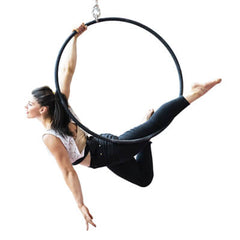
 Aerial Disciplines


 Handstand
 Balance
 Balls


 Clubs


 Juggling Rings
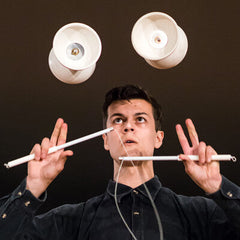 Diabolo
 Professional Silicone Clown Noses
 Manipulation Hats
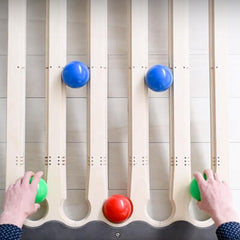 Juggle Board
 Soap Bubbles
 Circus Schools and Juggling courses
 Fire Props
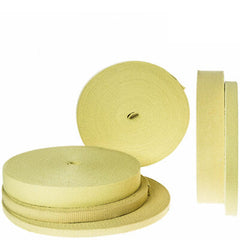 Kevlar® Wicks
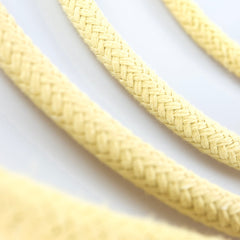 Kevlar® Ropes
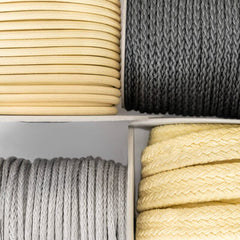 Special ropes in Technora and Kevlar®
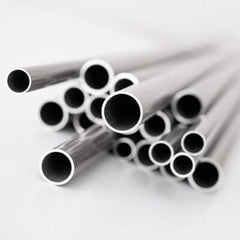 7075 - Tubing for fire prop manufacturers
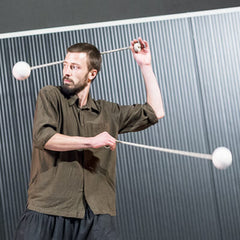 Contact Poi
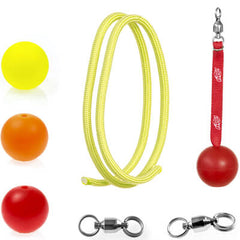 Poi and Flow Arts Components
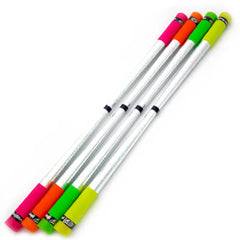 Devilstick
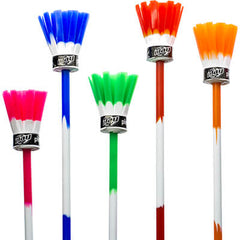 Flowerstick

How to choose CIRCUS DIVISION aerial silks
Start with four questions
CIRCUS DIVISION sells one professional silk, designed and made in Italy: 100% polyester, treated to reduce lengthwise stretch and to give grip. You do not choose between a “beginner silk” and a “professional silk”. You choose the cut, the width and the fixings that match a structure already verified by a competent person. If you are still learning, this page helps you order the size and the fixings your teacher indicated. Installation is only done on a structure that has already been checked.
- At what height from the floor is the already verified anchor point?
- Do you need the standard silk (160 cm) or the SLIM (130 cm)?
- Are you fixing to a concrete slab, wrapping a beam, screwing into a wooden beam, or do you already have the hook?
- Do you want a ready kit, or a by-the-metre cut at the exact length?
This page does not replace a course or a lesson with a teacher. Play sells aerial silks to people who already train, and to beginners followed by a competent teacher. Always put a certified crash mat under the silk. Do not train alone. Have a professional confirm that the ceiling or beam can take a dynamic aerial load before you order an anchoring kit.
The right length
Play lists silks as total length, end to end. The silk folds in half and hangs from the centre: working length, the length you climb on, is a little less than half. Specialist circus-equipment suppliers use the same convention. If another brand lists “working length”, do not treat the two numbers as the same measurement. Working length is about half the total length: if you mix them up, you order about half the silk you need, and you only see it once the silk is already hanging.
Play’s official formula accounts for the knot (about 0.5 m) and about 1 m of extra on the floor for wraps. Without that extra you do not have enough fabric on the floor to close the figures that start from the ground. If the silk is too short, you cannot lengthen it afterwards.
L = (H × 2) + 2 m
H is the height of the anchor point from the floor. Example: hook at 4 m → 8 + 2 = 10 m of silk.
| Height of the verified anchor | Silk to order |
|---|---|
| 2.5 m | 7 m |
| 3 m | 8 m |
| 3.5 m | 9 m |
| 4 m | 10 m |
| 4.5 m | 11 m |
| 5 m | 12 m |
| 5.5 m | 13 m |
| 6 m | 14 m |
| 7 m | 16 m |
| 8 m | 18 m |
These are working heights often used in circus schools and specialist shops. About 3 m of anchor (about 8 m of silk) is a frequent starting height for people beginning with a teacher: climbs, foot locks and most of the basic moves are done at that height, and the falling distance is shorter. Dynamic drops, meaning intentional falls in which the body travels some distance before the silk catches it, need more height: people who supply schools often talk of about 7 m of working height. The Fédération française des écoles de cirque (FFEC) gives 6.50 m as the reference height for professional performance. The silk is the same. What changes is the height of the room and, with it, the work that can be done safely.
A silk that is too long you shorten at the hook. One that is too short does not lengthen. If you work in more than one space, buy for the highest verified point. If the size does not fall in the 6–12 m or 13–20 m ranges, order the standard silk by the metre or the SLIM by the metre.
Standard 160 cm or SLIM 130 cm
The fabric family and the treatment are the same. The difference is how much cloth you close in the hand. Play developed the SLIM after teachers asked: they needed a silk that people with small hands could close without forcing the volume. On the climb, if the bundle slips through your fingers, the width is too much for your hand: the SLIM keeps the bundle narrower and easier to close.
The Standard, 160 cm (art. CDASK) is the default silk of circus schools, and the one most adults close in the hand. There is more fabric in the bundle: more volume to wrap and more grip to learn. It is the width used in most schools. Go to aerial silks. The SLIM, 130 cm (art. CDASKS) has a narrower bundle, and therefore it is easier to keep closed on the climb. It is meant for small hands, for children, and for anyone still building grip. Go to SLIM silks.
Width is chosen from the hand, not from how much experience you have. A professional with small hands uses the SLIM. A beginner with large hands uses the standard. If you buy for a class of different people, keep both: each person needs to be able to close the bundle in their own hand.
What this silk really is
Circus Division silks are 100% polyester, treated to reduce lengthwise stretch. Play’s spec sheets, and the circus schools that train on this silk, describe it as thicker and more grippy than a slippery decorative fabric: you climb with less effort and a slide is easier to control. The same silk is used both while learning and on stage, because the grip stays similar and a slide is easier to stop than on a smooth fabric.
Play does not split the catalogue into low, medium and high stretch silks. It sells one certified silk, treated to reduce lengthwise stretch and to give grip. A silk that stretches more can make a fall softer, but on the climb you have to take that stretch back and you spend more energy.
A stretch percentage is an arbitrary criterion, invented to distinguish the various types of fabric sold for aerial acrobatics. In practice, stretch cannot and should not be expressed as a percentage or as a “level”. The body weight of the person training and the length of the silk are two factors that strongly affect how much the silk itself stretches, so a generic coefficient does not describe what happens.
Think about it: if a 100 kg adult man and a 30 kg girl climb the same silk, is the stretch percentage the same? And if the silk is 3 metres long or 10 metres long, with the same body weight, does it stretch in the same way? The combination of these factors, on the same silk, changes its stretch a great deal.
There is another point. When the silk is new, it is bulkier and a little more elastic. After a few days of practice the fibres stretch and settle: the silk becomes thinner and loses some of its initial elasticity. Do not compare the stretch of a silk you have used for a year with that of the same product just bought. The new one needs a little time to settle, just like a pair of shoes you have just bought.
- Maximum working load of the standard silk: 150 daN (about 150 kg). Maximum breaking load: 1350 daN.
- Certification: European standard UNI EN 913:2019.
- Machine wash at 30 °C. Store dry.
- Maximum use: 3 years or 300 hours. Inspection by a competent person every 12 months or 100 hours, recorded on the life sheet.
The load of the system is always the weakest link: plate, anchors, beam, connector, hook. Read the silk technical specifications before you install.
The hook is part of the fixing
Fold the silk in half and fix it on the CIRCUS DIVISION hook with a clove hitch. The hook is a cylindrical stainless-steel core coated in silicone, with no welds and no metal showing. It keeps the two ends apart and spreads the load so the silk does not crush on the knot. Without that curve, the silk works on an edge. On an edge it wears sooner and holes appear more easily.
A climbing figure-eight descender, or any hardware with edges, is a frequent cause of holes at the hang point. Circus riggers warn that it can halve the silk’s life. If you do not already have a dedicated hook, buy it with the silk. Ready kits include it because the silk needs that piece so it does not work on an edge.
Details and loads: hook technical specifications.
Which anchoring for your ceiling
Stair treads, curtain poles, unverified trees and household furniture are not anchor points. Before you order, have a professional check the ceiling or the beam, as the warning above says. The kit changes according to the structure you fix to, not according to the experience of the person training.
| Your structure | What to order |
|---|---|
| Concrete slab | Silk + hook + ceiling plate with through-bolts. The 12 cm plate is sized for the joist spacing of domestic slabs. For a multi-point system on concrete, use an Agile kit for concrete. |
| Wooden beam to screw into | The same plate, supplied with wood screws. |
| Exposed beam to wrap | Silk + hook + beam kit (80 cm polyester strap + auto-locking carabiner). No drilling. |
| You already have a verified hook | The silk only, cut with the formula. |
| No suitable ceiling or beam | A freestanding aerial structure (TP420 / TP560 / TP700), on a suitable floor. |
Plate details: plate technical specifications.
Ready kit or by-the-metre cut
The ready kit is the shortest path if the length falls in a listed range. Every kit brings together the same certified silk and the fixings suited to that kind of room, so the hook or the plate that hold the system are not left out.
- Silk only. Order 6–12 m or 13–20 m, standard or SLIM, if you already have the rest of the hang.
- Silk + hook. Choose this if you already have a verified connector on the structure, and you are missing the piece that protects the silk.
- Silk + hook + plate. This is the kit for a concrete or wooden ceiling.
- Silk + hook + beam kit. Use this to wrap an exposed beam, without drilling.
- By the metre. Order the exact length from the formula, or a spare cut for the school.
Go to standard silks and kits or SLIM silks and kits.
By situation
At home, after a real course
Width according to the hands — standard if you close them, SLIM if the bundle slips — and kit according to the ceiling already approved by someone who knows. If you can, keep the height modest: for the basic moves, three metres of anchor is enough, and the falling distance is shorter.
School or gym
Standard 160 cm for the class; SLIM for young people and small hands, because the bundle is narrower and easier to keep closed. Inspection every 12 months or 100 hours. Retire at 3 years or 300 hours, or at the first hole. A spare silk means the class can still run if one silk is being inspected.
You are already working drops
For drops you do not need another Play silk. You need more height that has already been checked, and a structure suited to dynamic load. The model stays the same; the height and the structure change.
Before you put it in the cart
- A professional has approved the structure. Without that check, the kit does not make the ceiling safe.
- Length is calculated with L = (H × 2) + 2 m: fold in half, knot, extra on the floor.
- Width is standard 160 cm or SLIM 130 cm, according to how much fabric you close in the hand.
- Order the CIRCUS DIVISION hook with the silk, or it is already included in the kit.
- The anchoring kit matches concrete, wood screws or a strap on a beam.
- Under the silk there will be a certified crash mat.
- There will be a teacher or another competent person supervising.
Guide revision: 251004