 Aerial Disciplines


 Handstand
 Balance
 Balls
Balls


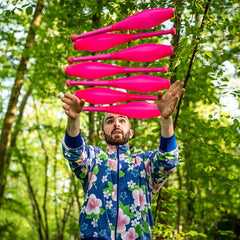 Clubs
Clubs


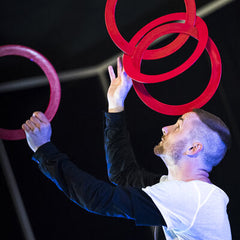 Juggling Rings
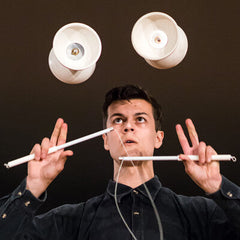 Diabolo
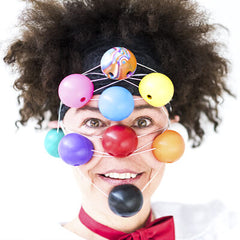 Professional Silicone Clown Noses
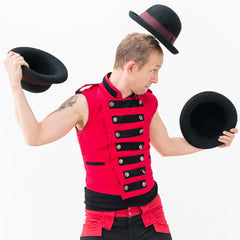 Manipulation Hats
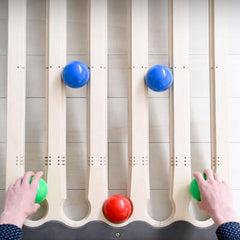 Juggle Board
 Soap Bubbles
 Circus Schools and Juggling courses
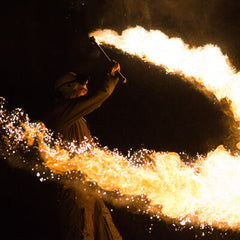 Fire Props
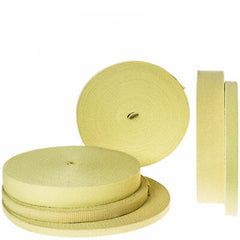 Kevlar® Wicks
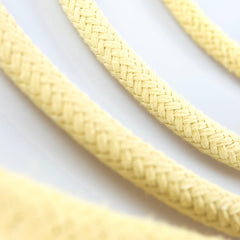 Kevlar® Ropes
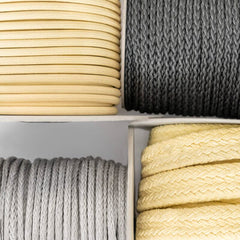 Special ropes in Technora and Kevlar®
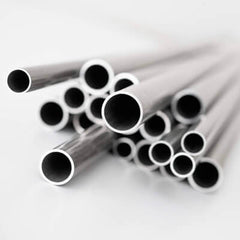 7075 - Tubing for fire prop manufacturers
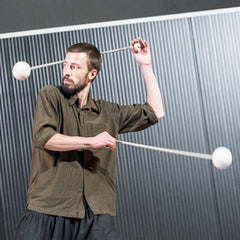 Contact Poi
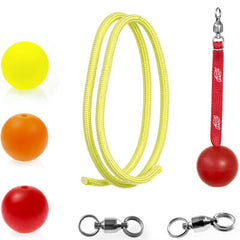 Poi and Flow Arts Components
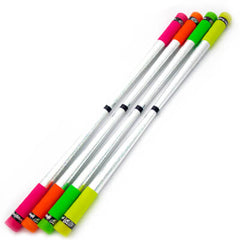 Devilstick
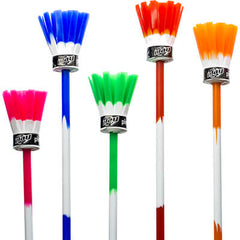 Flowerstick

How to choose contact balls
Start with four questions
Contact is the work of the ball on the body: you roll it, you hold it still in one place, you pass it from one hand to the other. It is not throwing in the air. Play has a very wide range for this kind of work: soft phthalate-free PVC balls, made in Italy (we call them stage balls), and hard acrylic spheres, in two grades of clarity. There is no ball that suits everyone. The choice depends on what you are learning now.
Be careful with advice from friends who are further along than you. It is often useful, but sometimes, once someone has a lot of practice, they recommend the prop they use today and forget what someone needs while learning the basics. The acrylic your friend uses now is, in the first months, too heavy, and it scratches easily on the floor. You end up protecting it instead of concentrating on the movement. Be honest with yourself. Do not start with the most expensive prop just because the people you look up to use it. Better to go step by step: once the basics are solid, there is always time to move to another ball.
- Are you learning to move one ball on the body, or do you already hold several balls in one hand?
- Does the ball still drop often, or do you already train for many hours with a stable movement?
- Do you need a ball that is soft and will not be ruined when it drops, or a sphere that is hard and slides well against the others?
- For a show, do you need a sphere that is very clear, or is a truly round sphere enough for training?
If you are starting with one ball, begin with the BS4 stage: 100 mm, 260 g. In the first months the ball drops often, and that is normal: that is how you learn to feel it. A 100 mm acrylic weighs 650 g and scratches on a rough floor. You spend more time protecting it than practising the movement. The BS4 weighs 260 g: heavy enough to stay on the body while you learn to guide it, and not so heavy that it tires the wrist and forearm straight away. This page is about contact. If you are looking for balls to throw in the air, there is the other guide.
Stage balls: the soft ball, for one ball only
Play builds, in Italy, the most used stage balls in the world. They are soft PVC, phthalate-free, calibrated and washable. They do not bounce. When they drop they stay close to you: in the first months that helps, because you can try the movement again straight away without chasing the ball across the room. The same balls are also used as the heads of contact poi, the poi that have a ball at the end of the rope.
For work on the body, two simple things matter: diameter and weight. A ball that is too small gets lost on the chest and shoulders, and at the beginning you cannot tell where it is. One that is too light slides off as soon as the movement is not precise. One that is too heavy tires the arm before you have learned the gesture.
BS4 — 100 mm, 260 g is the ball we suggest you start with. Not because it is “for beginners” in a dismissive sense, but because it brings together what you need while you are learning the basics.
- It costs relatively little, so you can drop it every day without worrying about an expensive object.
- Soft PVC does not scratch on the floor the way acrylic does. With a hard sphere, after the first scratches, it is easy to stop trying for fear of ruining it.
- 100 mm is a comfortable size to feel. You have enough surface to understand, by touch, where the ball is when you roll it on the body or hold it still in one place while you move around it. A smaller ball, at the beginning, gets lost on the chest and shoulders.
- 260 g is a middle weight. If the ball is too light, it slides off. If it is too heavy, the wrist and forearm tire quickly. At 260 g the ball stays on the body and you have time to guide it.
In the same size there is also the 100 mm at 200 g. The diameter does not change; the weight is lower. The ball sits a little less steadily on the body, because it has less weight holding it there, but it is lighter on the wrist and arm. It is still a stage ball, a soft contact ball. Choose it if 260 g already feels like too much.
BS5 — 130 mm, 400 g is larger and heavier than the BS4, and for that reason it is easier to control on the body. It is not a required next step. It is more surface and more weight: the rolls are easier to see and to feel, and if the movement is not precise yet the ball gives you more margin. People who are just starting also find it simple on the body. 400 g is still well below the 650 g of a 100 mm acrylic. The only practical drawback is that it takes more room in a bag. Choose it if you want the ball that is easiest to keep on the body and you do not mind carrying it.
The 80 and 90 mm are smaller balls, made for someone who wants to use the same ball both for throws in the air and for some work on the body. The 80 is glossy, the 90 is matte. They make sense once you can already throw and you want to add rolls. If you are learning contact only, they are less suitable: because they are smaller they lose contact sooner, and the gesture pulls you toward throwing three balls in the air rather than rolling on the body. You will find them in the stage collection.
Acrylics: when you work with several balls in one hand
Two soft balls, held in the same hand, tend to stick to each other. The movement you use to settle them in the palm becomes imprecise. When you want to hold two or three balls in one hand and let them slide against each other, you need a hard surface with little friction. That work is called multi. For it you use acrylic spheres: they are solid, hard, and they slide against each other. They stand up to impacts, but on a rough floor they scratch.
They are not the first purchase. They make sense once you can already roll and control one ball on the body, and you want to learn another skill: several balls in the same hand. If you start with acrylic before those basics, the weight and the fear of scratching it distract you from the movement.
The sizes below take account of how this multi-ball work is trained. They are not a judgement of level. Most people start at 70–75 mm (76 mm on Ultra Clear). A sphere of this size sits in the hand without forcing you to open the fingers too wide, and you can learn to settle the balls in the palm without fighting a diameter that is too large. You move to 80–85 mm when the hand is already used to staying open and you want a ball with more presence, including in weight. The 90–100 mm are for when you work with few balls, or with a single ball on stage: the 100 mm weighs 650 g. It is not a better version of the 70 mm; it is a much heavier object. The 120 mm reaches 1130 g: it is a stage presence, not a size for long training sessions.
In training, people use gradually larger balls so the hand learns to stay open and the movements become smoother. It is not a ladder to skip. Going straight to a 100 mm acrylic, with three balls in the hand, asks for a hand that is already trained. If that practice is not there yet, the weight is felt at once in the wrist and forearm.
Standard or Ultra Clear
Standard is an imported sphere, truly round, at an accessible price. For learning how the balls slide against each other, it is enough. Next to an Ultra Clear you can see that it is less transparent: that is a difference in the material, not a fault in the making. If you do not perform, it is the right ball for the gym, where it will drop often.
Ultra Clear is made in Italy, in PMMA. The clearest sheets are made by casting acrylic resin with little catalyst: the process is slower and the block is clearer, so much so that in person it looks like glass. If more catalyst is used, production is faster and costs less, but the sphere is less transparent. Ultra Clear is the set to keep for the stage, when light has to pass through the ball and the clarity has to read from a distance. For everyday training, use the ball you can drop without thinking about it.
By situation
One ball, on the body
Start with the BS4, 100 mm, 260 g. It is the ball we point to for people who are learning, because you can drop it without ruining it and the weight stays manageable on the wrist and arm. If you want still more surface and easier control, and the bulk does not bother you, take the BS5, 130 mm, 400 g. The 100 mm at 200 g is the same idea, lighter, if 260 g feels like too much. The 80 or 90 mm come later, if you also want to use the same ball for throws in the air.
Several balls in one hand
Here you need acrylic, not a “more professional” stage ball. Start at 70 or 75 mm (76 mm on Ultra Clear): the hand learns to open without fighting a diameter that is too large. Move to 80 or 85 mm when that movement is already stable. Use Standard for training and for dropping the ball. Keep Ultra Clear for the show, when the clarity has to be visible from a distance.
Before you buy
- You are buying contact balls, for work on the body, not balls to throw in the air. For those, there is the other guide.
- One ball: a BS4 stage, or a BS5 if the bulk is fine for you. Do not start with a 650 g acrylic.
- Several balls in one hand: acrylics, starting at 70–75 mm. You go up in diameter when the hand is already used to it, not before.
- Standard for training, when the ball drops. Ultra Clear for the stage, when you need the clarity.
Guide revision: 261005